
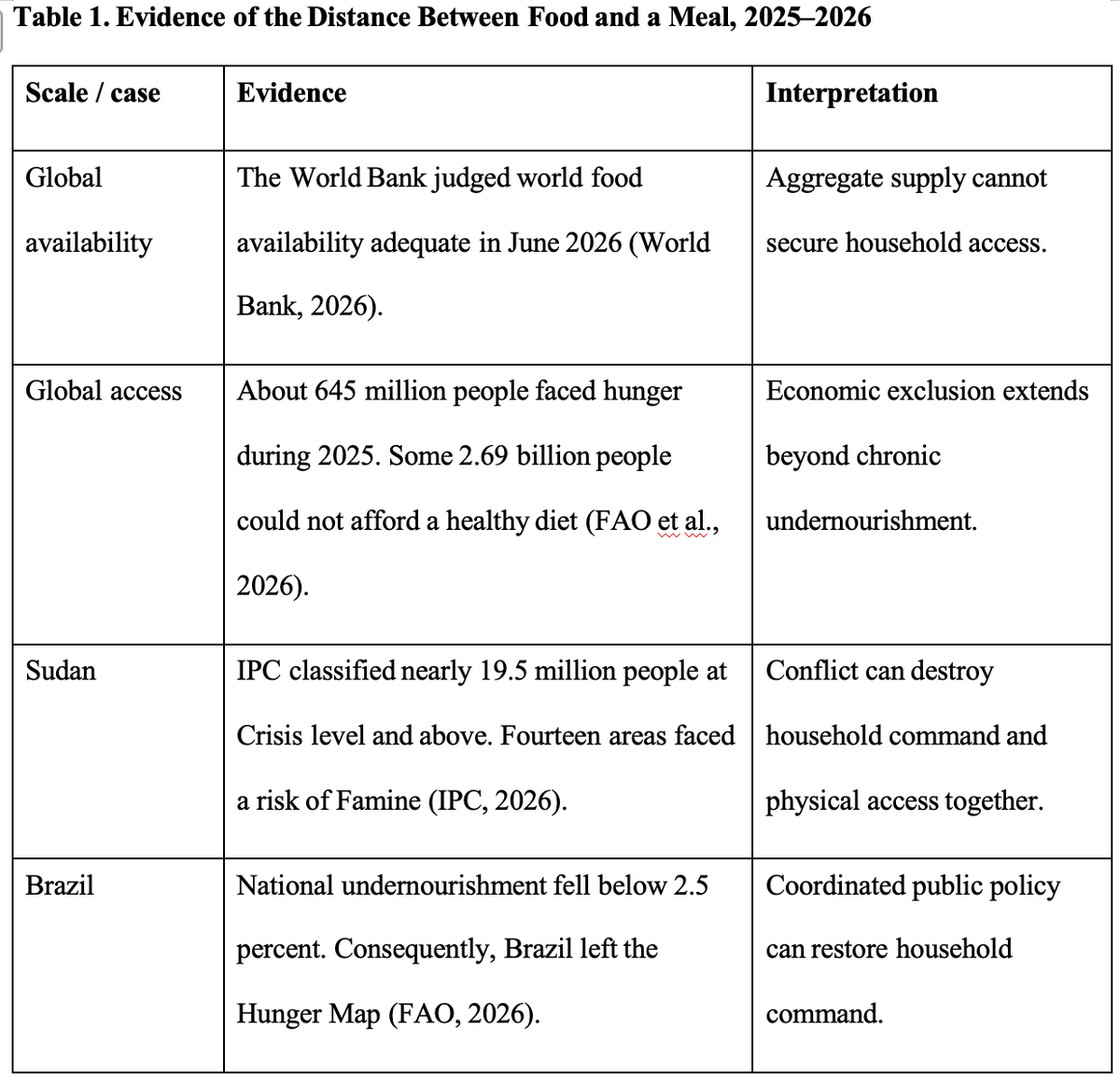
In June 2026, the World Bank judged global food availability adequate. Several weeks later, five United Nations agencies estimated that 645 million people experienced hunger in 2025. The same publication also estimated that 2.69 billion people could not afford a healthy diet (FAO et al., 2026). There is an interesting contradiction with food production that can fill granaries without allowing some households a single meal. Prices and physical access are responsible for part of the distance between the granary and the dining table. Meanwhile, rights and public protection are also significant factors. Global agriculture has improved its productive reach much faster than public institutions have secured human access to food. Market access and public institutions allow hunger to continue via their determination and sometimes the negation of access for some groups. In many regions suffering from conflict and climatic extremes, public commitments have not succeeded in restoring access at scale. Therefore, the distance between food and a meal measures unequal control over resources and inadequate protection against loss. Hunger survives abundance since crops and access constitute different achievements. Furthermore, the widespread issue of hunger outlives known remedies as finance and accountability have lagged behind aspiration.
Sen (1981) has expounded this contradiction with its perhaps most famous explanation by arguing that famines can unfold amid adequate national stocks after households lose the means to acquire food. Families may lose earnings and productive assets as a result of exchange opportunities closing and public transfers vanishing. Sen has called these routes ‘entitlements’: socially recognized means of commanding food. The concept of ‘entitlements’ deals with a wholly different household question: can this person command a meal today? No stock count can answer this issue since formal rights may coexist with practical exclusion. This insight has progressed famine analysis beyond crop totals without making scarcity irrelevant. Drought shrinks harvests, and siege halts deliveries. Tezanos-Vázquez (2025) has highlighted that modern famines can combine availability losses and failed exchange. Political protection may collapse at the same time. Scale resolves the apparent conflict since global calories cover human energy demands even as towns under siege lack grain. Costlow et al. (2025) have shown that global calories satisfy aggregate energy demand. Several nutritious food groups fall short of healthy diet benchmarks. Therefore, abundance makes universal nourishment possible. Entitlements put food within reach as public protection keeps access intact during crisis, although scarcity still deserves analytical weight. The market's distribution of available food cannot guarantee human access, as food may fill a port after the purchasing power of nearby families has disappeared.
Daily access often falters at the checkout long before famine classifications become relevant. Markets allocate food according to purchasing power and cannot read hunger. Severe deprivation creates no effective bid without income. SOFI 2026 estimates that 2.1 billion people experienced at least moderate food insecurity in 2025. Moderate food insecurity differs from chronic undernourishment. The 645 million estimate tracks habitual dietary energy deficiency. The 2.69 billion figure compares healthy diet costs against household income. Reading them separately makes the paradox more intriguing. Healthy diets cost 4.28 purchasing-power-parity dollars per person each day, up from 2.94 in 2017 (FAO et al., 2026). Consequently, food has become physically present and economically absent. Consumer prices reflect much more than farmgate costs. FAO et al. (2026) estimate that post-farmgate activity has accounted for 70 to 75 percent of consumer prices. Processing and distribution account for up to 2/5 of the total. Roads shorten the distance to market, and cold storage preserves nutritious foods until arrival. Inflation then decreases the purchasing power of wages, while asset losses deprive smallholders of crops and cash. Social protection counters that failure by transferring purchasing power before skipped meals become malnutrition. Barreix Sibils et al. (2024) have analyzed 46 low- and middle-income countries over two decades, with findings indicating that greater coverage mitigated undernourishment during economic downturns, especially in poorer countries. This longitudinal evidence identifies an important point of intervention without attributing every national change to cash transfers. Income support protects demand after wage loss as infrastructure cuts distribution costs before prices reach shops. Moreover, food waste cannot restore purchasing power. Surplus across an ocean has no nutritional value to a family separated from it by a closed road. Waste indicates unequal allocation, with redistribution still facing logistical and political barriers.
The situation of Sudan epitomizes this distance under wartime collapse. The May 2026 IPC analysis classified nearly 19.5 million people at the crisis level and above. That figure represented about 41 percent of the population. The analysis classified no area as famine, although fourteen areas faced risk under a reasonable worst-case scenario (IPC, 2026). Data gaps prevented a full nationwide projection for the subsequent lean season. That absence gives no warrant for reassurance. Conflict has displaced households and stripped assets as fighting has blocked access to farmland and roads. Farmers lose fields and livestock as wage earners lose their livelihoods. Checkpoints raise transport costs. Traders may abandon dangerous routes. Moreover, a siege can block aid after the collapse of private routes. Shemyakina (2022) has explored conflict effects across displacement and production loss. The findings have highlighted that market restrictions and predation further the damage. The current Sudan analysis follows the same progression as conflict restricts movement and aid obstruction increases household losses. The 19.5 million figure describes acute household food insecurity and says nothing about the global calorie total. Humanitarian restrictions then eliminate the public backstop since aid cannot reach households until authorities permit goods and people to move. Sudan does not exemplify every story of hunger. However, simultaneous failures provide the case with its analytical value, as one soon notices that global abundance crosses no checkpoint and restores no stolen herd. Chronic deprivation may erode access gradually with the destruction of several routes in a week by the ongoing war. That contrast highlights the inadequacy of a simple production answer since more grain elsewhere cannot reopen a market here. International grain stocks register availability at a scale irrelevant to besieged towns until the return of access. In Sudan, entitlement collapse moves from diagrams into lives.
Climatic extremes increase the same distance in a different manner. For instance, drought shrinks local harvests, and flooding destroys assets and roads. Heat may cause prices to skyrocket as yields fall. Awoke and Brück (2026) have synthesized recent household evidence. Climate and conflict crises coincided with poorer food consumption and less dietary diversity. Households also adopted harsher coping strategies, and effects varied relative to assets and institutional support. Two families may deal with the same drought and experience different diets afterward because savings buy time and public transfers extend it. Passable roads preserve market access after local crops fail. Therefore, climate may begin the crisis with public protection, then determine its human cost. Production investment improves local availability without protecting households after income loss, since harvest policy without social protection leaves families exposed between seasons. More global grain could coexist with hunger following local weather damage. Prior inequality and public response assign the final burden of what some may blame on the climate. Political institutions determine the final step from hardship to hunger.
Brazil tests the argument from the opposite direction with the FAO confirming that national undernourishment had fallen below 2.5 percent (FAO, 2026). Consequently, Brazil has left the Hunger Map. The threshold marks a measurable national reversal without implying zero hunger. Brazil has integrated income protection with institutions connecting farmers and consumers (FAO, 2025). Bolsa Família gives poor households purchasing power, and school meals secure food access for pupils. Public procurement programs then buy from family farmers. Casagrande et al. (2024) compared participating family farms with similar nonparticipants across time. The results indicated higher production values and steadier rural income among participants. This evidence suggests a practical approach from public purchasing to producer security without explaining the entire national decline. Iannotti et al. (2024) have reviewed evidence supporting cash transfers and food aid for affordability. School meals produce additional benefits with cash protecting household command and school meals securing child access. Procurement supports vulnerable producers as public coordination provides these measures with continuity. Moreover, public policy has connected consumer assistance with rural production. This pairing changes allocation twice: families gain purchasing power, and farmers gain a buyer. National history provides no control group, and economic conditions have also contributed to the trajectory. The counter-case supports the possibility without proving a single national cause. The sole factor of agricultural output fails to account for the later improvement. The cases serve different analytical purposes, as Sudan exposes collapse under war and Brazil showcases institutional recovery inside a large agricultural economy. Brazilian institutions have shortened the distance by protecting household command, and another large harvest could not have done the same work by itself. The following table condenses this contrast across global estimates and national cases.
Humanity already knows many policies capable of shortening this distance, although knowledge has not secured execution. Zorbas et al. (2025) have examined global commitments concerning Sustainable Development Goal 2. Commitments are named ambitious goals without having specified enough scalable actions. Financing plans stayed weak with sparse accountability provisions. Declarations can promise food security without assigning costs and omit consequences for failure. Pilot programs expire after grants end since ministries pursue conflicting priorities. Execution then stalls between institutions, and hunger survives during episodic access protections. Furthermore, transport policy adds another layer, as distributed responsibility gives failure plausible deniability. Governments may celebrate harvests even as households skip dinner. Therefore, the final distance is administrative and political. Policies get their scale and continuity from finance and accountability. Household access after a shock provides the proper test for food policy, with grain tonnage providing an otherwise incomplete one. The right to food acquires meaning after institutions fund it and make failure costly. Legislatures must write budgets before a crisis because speeches afterward give little nourishment. Implementation is the quiet politics that decides whose entitlement survives the next shock, with the concept of abundance becoming statistical comfort in the absence of execution.
The distance between food and a meal can stretch across a battlefield and also fit inside the price tag on a shop shelf. Global production in the 21st century has made enough food available to solve the first problem: existence. Income and institutions must now tackle the second: access. The entitlement framework developed by Sen explains the missing passage between them, with conflict and climatic extremes having disrupted that passage. The case of Sudan has showcased the stakes, with Brazilian examples also exemplifying reversibility. Food waste exposes the moral absurdity in real-life scenarios without replacing access to institutions. Hunger survives abundance because productive capacity has never guaranteed command over its results. Therefore, ending hunger means the protection of command before shocks and its restoration immediately after loss. The world has solved the arithmetic of abundance more successfully than the politics of access. Abundance is possibility. Justice gives that possibility a daily destination: a meal.
References
Awoke, M. D., and Brück, T. (2026). Climate, conflict, and food security: A systematic review of household-level evidence (2020-2025). Journal of Health, Population and Nutrition, 45, 70. https://doi.org/10.1186/s41043-026-01267-0
Barreix Sibils, G., Brachowicz, N., Silva, N. J., Landin, E., Macicame, I., Naidoo, M., de Sampaio Morais, G., and Rasella, D. (2024). The mitigating effect of social protection on undernourishment during economic downturns: A longitudinal study of 46 low- and middle-income countries over the last two decades. Social Science & Medicine, 361, 117365. https://doi.org/10.1016/j.socscimed.2024.117365
Casagrande, D., Emanuel, L., Freitas, C., Lima, A., Nishimura, F., and Oliveira, F. (2024). Public food procurement and production: Evidence of the food acquisition program in Brazil. Food Policy, 126, 102656. https://doi.org/10.1016/j.foodpol.2024.102656
Costlow, L., Herforth, A., Sulser, T. B., Cenacchi, N., and Masters, W. A. (2025). Global analysis reveals persistent shortfalls and regional differences in availability of foods needed for health. Global Food Security, 44, 100825. https://doi.org/10.1016/j.gfs.2024.100825
FAO. (2025). The Alimenta Cidades (Feeding Cities) Strategy in Brazil: Catalysing policy alignment from the municipal level. https://www.fao.org/food-systems/news/news-detail/the-alimenta-cidades-%28feeding-cities%29-strategy-in-brazil--catalysing-policy-alignment-from-the-municipal-level/en
FAO. (2026). FAO members in Latin America and the Caribbean discuss priorities in fighting hunger and poverty. https://www.fao.org/newsroom/detail/fao-members-LARC39-fighting-hunger/en
FAO, IFAD, UNICEF, WFP, and WHO. (2026). The State of Food Security and Nutrition in the World 2026: Understanding and addressing the high cost of a healthy diet. Rome: FAO. https://doi.org/10.4060/cd8306en
Iannotti, L., Kleban, E., Fracassi, P., Oenema, S., and Lutter, C. (2024). Evidence for policies and practices to address global food insecurity. Annual Review of Public Health, 45, 375-400. https://doi.org/10.1146/annurev-publhealth-060922-041451
IPC. (2026). Sudan: Acute food insecurity situation for February-May 2026 and projections for June-September 2026 and October 2026-January 2027. https://www.ipcinfo.org/ipc-country-analysis/details-map/en/c/1163315/
Sen, A. (1981). Ingredients of famine analysis: Availability and entitlements. The Quarterly Journal of Economics, 96(3), 433-464. https://doi.org/10.2307/1882681
Shemyakina, O. (2022). War, conflict, and food insecurity. Annual Review of Resource Economics, 14, 313-332. https://doi.org/10.1146/annurev-resource-111920-021918
Tezanos-Vázquez, S. (2025). Why do famines still occur in the 21st century? A review on the causes of extreme food insecurity. Journal of Economic Surveys, 39(4), 1433-1461. https://doi.org/10.1111/joes.12661
World Bank. (2026). Food security update, June 2026. https://www.worldbank.org/en/brief/2023/06/09/food-security-update
Zorbas, C., Resnick, D., Jones, E., Suri, S., Iruhiriye, E., Headey, D., Martin, W., Vos, R., and Menon, P. (2025). From promises to action: Analyzing global commitments to tackle hunger and food insecurity. Food Policy, 136, 102968. https://doi.org/10.1016/j.foodpol.2025.102968