
Introduction
“Enough” in the question of whether the world produces enough food is almost always measured at the moment a crop leaves the field, not at the moment a person eats, and that single choice of measurement point carries more weight than it first appears to. Counted at harvest, global agriculture already clears the bar with room to spare. Counted at the plate, after a large share of those harvested calories has been diverted into livestock feed, fuel tanks, and supply chains that lose food along the way, the surplus mostly disappears.
Two separate failures produce that gap, and neither one alone explains why it persists. The first is a straightforward matter of energy: converting a crop into meat or fuel destroys most of the crop's caloric value before a human ever consumes it. The second is a matter of institutions: the agencies, subsidy programs, and research infrastructures that govern global agriculture were built in the mid-twentieth century to solve a production shortage that no longer exists, and they have kept rewarding exactly the metric, tonnage grown, that the energy loss hides behind. What follows treats persistent hunger less as a story about scarcity or greed than as a story about a system optimizing, with real success, for a target that stopped being the right one decades ago.
I. The Energy a Crop Loses Before It Reaches Anyone
Gr
own for direct human consumption, existing global cropland could feed several billion more people than it currently does, not through any new technology but simply through reallocation of crops already being harvested. Analysis of worldwide crop production found that shifting calories currently diverted to animal feed and biofuel back toward direct human food could increase available food calories by as much as 70%, enough to feed an additional four billion people beyond current output, a figure larger than the entire population growth the planet is expected to add over the coming decades (Cassidy, West, Gerber, & Foley, 2013). Complementary modeling of the broader agricultural system reaches a similar conclusion from a different angle, showing that closing yield gaps and reallocating existing crops toward direct consumption could meet future food demand without further agricultural expansion at all, sidestepping the usual assumption that feeding more people requires farming more land (Foley et al., 2011).
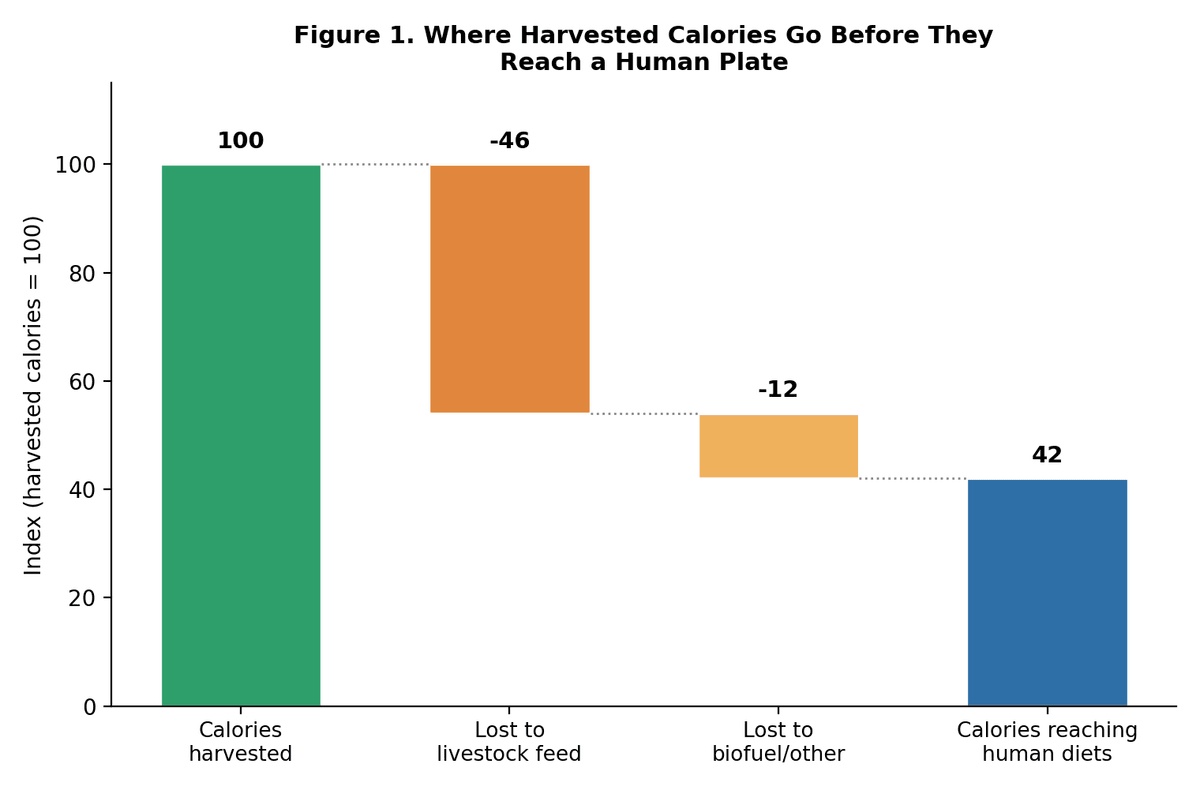
Figure 1. Well under half of harvested calories survive the journey from field to plate once feed and biofuel diversion are counted (illustrative synthesis based on Cassidy et al., 2013).
Livestock production accounts for most of that loss, and the loss is not evenly distributed across animal products or equally indefensible in every case. Measuring caloric and protein conversion efficiency across major categories of American livestock, researchers found that beef returns only about 3% of the energy invested in its feed, with poultry and eggs performing several times better but still discarding the large majority of the original input (Shepon, Eshel, Noor, & Milo, 2016). Figure 2 places these efficiencies side by side, and the pattern that emerges is not a case for eliminating livestock altogether, since animals raised on grass or agricultural byproducts convert biomass humans cannot digest into food humans can, a genuine efficiency gain rather than a loss that no aggregate conversion statistic captures on its own (Smil, 2000). The pattern is instead a case against the specific, dominant practice of feeding animals grain that could otherwise be eaten directly, a practice institutions have had every incentive to expand rather than question, for reasons the next section traces to their founding design.
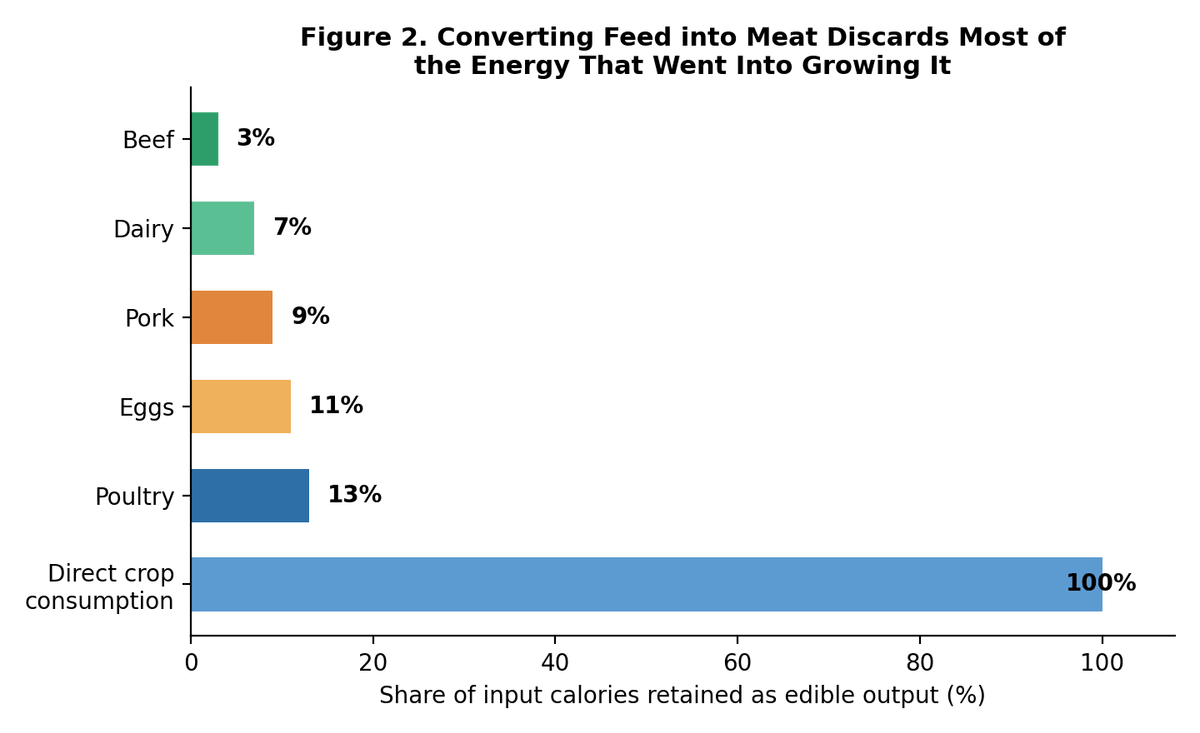
Figure 2. Feed-to-food conversion destroys most of a crop's caloric value before it becomes meat, with beef the least efficient major category by a wide margin (Shepon et al., 2016).
II. A System Still Fighting the Last War
None of this energy loss is secret or difficult to calculate, which raises the harder question of why institutions charged with global food security have not reorganized around it after decades of available evidence. Part of the answer lies in when those institutions were designed and what problem they were designed to solve. Agricultural research stations, seed-breeding programs, and international aid architecture built in the 1940s through 1960s were assembled explicitly to solve a production crisis, driven as much by Cold War strategic anxiety about which political bloc would feed the developing world as by hunger itself, and their founding metric was straightforwardly tonnage per hectare, a target that made sense in a world where the primary constraint really was insufficient production (Perkins, 1997).
That founding choice did not stay confined to its founding decade, even after the underlying constraint it was built to solve had largely changed shape. Extending the analysis into the twenty-first century, research on what has been termed the long Green Revolution finds the same production-maximizing logic still governing agricultural philanthropy, national subsidy design, and international lending, carried forward less by active decision than by the institutional relationships, financing structures, and expertise built up around the original goal across three generations of agricultural policymakers (Patel, 2013). Political science offers a name for why goals this old prove so durable: path-dependent institutions generate increasing returns, in which every year a policy operates deepens the constituencies, expertise, and infrastructure built around it, making reversal progressively more costly even after the policy's original justification has faded from view (Pierson, 2000).
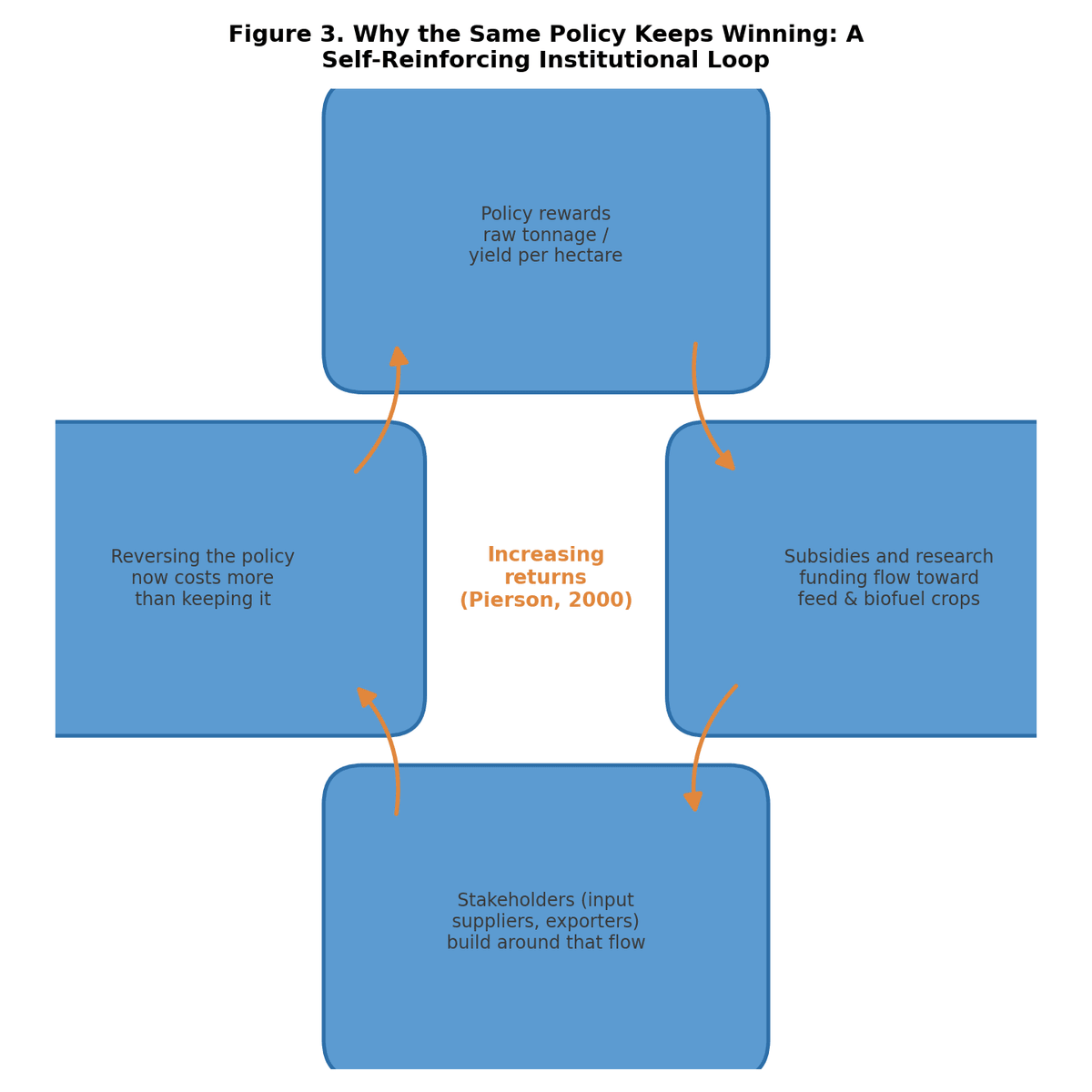
Figure 3. A subsidy structure built to maximize tonnage generates its own constituency for staying unchanged, regardless of whether tonnage is still the right target (Pierson, 2000; Patel, 2013).
Contemporary agricultural subsidy structures illustrate the loop concretely rather than abstractly. National subsidy programs continue to link the largest payments to volume produced and to specific commodity categories, feed grains and oilseeds prominent among them, rather than to the nutritional value delivered per unit of land, which keeps public money flowing toward exactly the crops most likely to be diverted into feed and fuel (OECD, 2024). None of this requires any administrator to be acting in bad faith. Every actor in the loop is responding rationally to the incentives already in place, which is precisely what makes the loop self-reinforcing rather than self-correcting.
III. What Counting Differently Would Require
Measuring food security only by aggregate calories available, whether at harvest or globally averaged, has always been able to coexist with severe, localized shortfall, since a market or a state can hold ample food in aggregate while specific households hold no effective claim on any of it (Sen, 1981). Modern food security frameworks acknowledge this by defining the concept along multiple dimensions, availability, access, utilization, and stability, rather than availability alone, but the institutions that fund and regulate agriculture have been slower to update their internal metrics than the definitions used to describe the problem (Godfray et al., 2010; Barrett, 2010). Whose access counts as a policy failure worth correcting, rather than an unfortunate byproduct of otherwise successful aggregate growth, is itself a question of institutional standing as much as measurement, since a household with no voice inside the agencies that set subsidy priorities has no reliable channel for converting its shortfall into a claim those agencies are obligated to answer (Fraser, 2000).
Correcting the energy loss identified in Section I and correcting the institutional lock-in identified in Section II are not two separate projects competing for attention, since the second is largely why the first has gone uncorrected for as long as it has, and treating them as independent problems is what has allowed decades of accurate energy accounting to accumulate without producing a matching policy response. Reallocating land away from feed and biofuel crops would require agricultural policy to reward nutritional delivery rather than tonnage, which is exactly the design choice path-dependent institutions resist making regardless of the strength of the underlying evidence, since the constituencies built around the current metric have no comparable stake in whichever metric might replace it (Devereux, 2001). Recent global assessments continue to describe adequate or growing aggregate production alongside stagnant or worsening access in specific regions, the same disconnect in contemporary form that this argument has traced back to its mid-century institutional origin rather than to any new or unprecedented failure (World Bank, 2026; FAO, IFAD, UNICEF, WFP, & WHO, 2023).
Conclusion
Persistent hunger, on the account assembled here, is not best explained as a production failure, a distribution failure, or an institutional failure taken separately, but as three descriptions of a single, coherent system doing exactly what it was built to do. The system was built to grow more tonnage, and it grows more tonnage, reliably, year after year; it was never built to ask what happens to that tonnage afterward, and so a majority of it can be diverted into feed and fuel while the institutions responsible declare the underlying goal met. The uncomfortable implication is that the metric everyone agrees to track, aggregate production, has become part of the mechanism that keeps the real shortfall invisible rather than a neutral gauge of progress against it, a shortfall that carries lasting cost for the households living inside it, since even brief nutritional decline is associated with measurably worse health outcomes years later (Gundersen & Ziliak, 2015).
Two limitations are worth stating plainly. The specific efficiency and subsidy figures cited here are drawn primarily from United States and global aggregate data, and applying the same causal story to every national agricultural system risks flattening real differences in how, and how recently, individual countries built their own institutions. The argument has also stopped short of specifying which reform would break the loop in Figure 3 first, whether shifting subsidy eligibility toward nutritional yield, funding parallel research infrastructure outside the incumbent institutions, or some combination, and testing which lever actually moves entrenched agricultural policy, rather than simply diagnosing why it has not moved so far, is the natural next step this account leaves for further work.
References
Barrett, C. B. (2010). Measuring food insecurity. Science, 327(5967), 825–828. https://doi.org/10.1126/science.1182768
Cassidy, E. S., West, P. C., Gerber, J. S., & Foley, J. A. (2013). Redefining agricultural yields: From tonnes to people nourished per hectare. Environmental Research Letters, 8(3), 034015. https://doi.org/10.1088/1748-9326/8/3/034015
Devereux, S. (2001). Sen's entitlement approach: Critiques and counter-critiques. Oxford Development Studies, 29(3), 245–263. https://doi.org/10.1080/13600810120088859
Food and Agriculture Organization, International Fund for Agricultural Development, UNICEF, World Food Programme, & World Health Organization. (2023). The state of food security and nutrition in the world 2023. FAO.
Foley, J. A., Ramankutty, N., Brauman, K. A., Cassidy, E. S., Gerber, J. S., Johnston, M., Mueller, N. D., O'Connell, C., Ray, D. K., West, P. C., Balzer, C., Bennett, E. M., Carpenter, S. R., Hill, J., Monfreda, C., Polasky, S., Rockström, J., Sheehan, J., Siebert, S., Tilman, D., & Zaks, D. P. M. (2011). Solutions for a cultivated planet. Nature, 478(7369), 337–342. https://doi.org/10.1038/nature10452
Fraser, N. (2000). Rethinking recognition. New Left Review, 3, 107–120.
Godfray, H. C. J., Beddington, J. R., Crute, I. R., Haddad, L., Lawrence, D., Muir, J. F., Pretty, J., Robinson, S., Thomas, S. M., & Toulmin, C. (2010). Food security: The challenge of feeding 9 billion people. Science, 327(5967), 812–818. https://doi.org/10.1126/science.1185383
Gundersen, C., & Ziliak, J. P. (2015). Food insecurity and health outcomes. Health Affairs, 34(11), 1830–1839. https://doi.org/10.1377/hlthaff.2015.0645
OECD. (2024). Agricultural policy monitoring and evaluation 2024. OECD Publishing.
Patel, R. (2013). The long green revolution. Journal of Peasant Studies, 40(1), 1–63. https://doi.org/10.1080/03066150.2012.719224
Perkins, J. H. (1997). Geopolitics and the green revolution: Wheat, genes, and the Cold War. Oxford University Press.
Pierson, P. (2000). Increasing returns, path dependence, and the study of politics. American Political Science Review, 94(2), 251–267. https://doi.org/10.2307/2586011
Sen, A. (1981). Ingredients of famine analysis: Availability and entitlements. Quarterly Journal of Economics, 96(3), 433–464. https://doi.org/10.2307/1882681
Shepon, A., Eshel, G., Noor, E., & Milo, R. (2016). Energy and protein feed-to-food conversion efficiencies in the US and potential food security gains from dietary changes. Environmental Research Letters, 11(10), 105002. https://doi.org/10.1088/1748-9326/11/10/105002
Smil, V. (2000). Feeding the world: A challenge for the twenty-first century. MIT Press.
World Bank. (2026). Food and Nutrition Security Update, Edition 123, June 2026. https://thedocs.worldbank.org/en/doc/40ebbf38f5a6b68bfc11e5273e1405d4-0090012022/related/Food-and-Nutrition-Security-Update-edition-123-June-2026.pdf